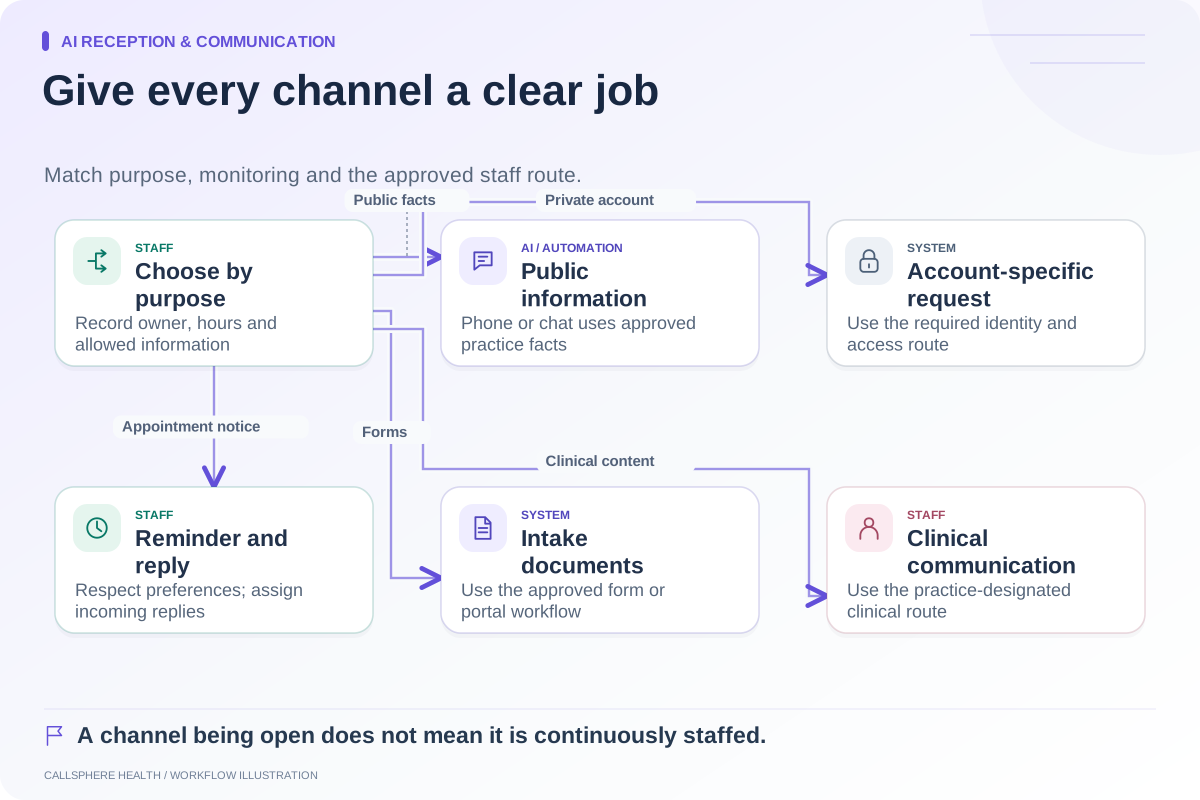
You are between sessions with nine minutes to return three calls. The first is a new referral who left a number. The second is an existing client who wants to move Thursday's appointment. The third is a voicemail from a number you do not recognize. You dial the referral back, it rings, and you get their voicemail. Now you have a decision to make in about two seconds: what do you say? Do you name your practice? Do you say you are returning their call about scheduling? Do you say the word "therapy" out loud, into a voicemail box you have no control over, that might play through a car speaker with a partner in the passenger seat?
That two-second decision is a HIPAA decision, and for a solo mental health therapist it is one of the most under-examined risks in the whole practice. This is a practical guide to HIPAA compliant voicemail and messaging for behavioral health: what you are actually allowed to leave, why psychotherapy callbacks are more sensitive than almost any other kind of medical message, and how to take the guesswork out of it so you are not re-deciding the script on every single callback.
What HIPAA Actually Permits You to Leave on a Voicemail
Start with the good news: the Privacy Rule does not prohibit leaving voicemails. HHS has been explicit about this. A covered provider may leave a message on an answering machine or voicemail, and may leave a message with a family member, to the extent it does not conflict with the patient's stated preferences. The Office for Civil Rights has said so directly in its guidance on communications with patients.
The catch is the standard that governs how much you leave: minimum necessary. Under 45 CFR 164.502(b), a covered entity must limit the use and disclosure of protected health information to the minimum necessary to accomplish the intended purpose. For a callback, the intended purpose is simple. You want the person to call you back. That purpose is fully served by your name and a phone number. It is not served by the reason for the visit, the diagnosis, the type of provider you are, or the time of an appointment.
So the boundary is not "voicemail yes or no." It is content. OCR's own example in the appointment-reminder context is instructive: a reminder that says "please call to confirm your appointment" is fine, while a message that discloses the nature of the treatment is a problem. The message is a permitted disclosure; the clinical detail inside it is the exposure.
For behavioral health, the calculus tightens further, because the mere fact that a person is your patient can itself be sensitive PHI. Confirming that someone is seeing a therapist, to a household member who did not know, is a disclosure with real consequences. That is why the safe default for a psychotherapy practice is narrower than for a dermatology or dental office.
Why Behavioral-Health Voicemails Carry Extra Exposure
Three things make therapy voicemails riskier than the average appointment reminder.
First, the shared-device problem. Voicemail boxes are not private. They play in kitchens, in cars, on speakerphone, and they get checked by spouses, parents of adult children, and roommates. A dermatology reminder overheard is mildly awkward. A message revealing that a person is in couples counseling, in substance-use treatment, or seeing a trauma specialist can trigger a family conflict, a custody dispute, or worse. The minimum necessary PHI phone calls front desk discipline exists precisely for this: you assume the wrong person will hear it.
Second, association is disclosure. If your outgoing caller ID or your practice name says "Riverside Trauma and Recovery Counseling," you have disclosed the nature of care before you say a single word. Simply returning a call from a recognizable behavioral-health line can out a client. Many therapists deliberately use a neutral practice name or a personal-sounding callback for this reason.
Third, patient preferences and restrictions carry weight here. Under 45 CFR 164.522, a patient can request confidential communications by alternative means or at alternative locations, and providers must accommodate reasonable requests. A client who says "never leave a voicemail, text me only" has made a request you are obligated to honor. If you leave a voicemail anyway because you were rushing between sessions, you have not just been sloppy, you have overridden a documented restriction.
Here is how the exposure cascades when the script is improvised rather than fixed.
flowchart TD
A[Therapist returns call between sessions] --> B{Fixed minimum<br/>necessary script}
B -->|No| C[Improvised message]
C --> D[Names practice specialty]
C --> E[States appointment reason]
C --> F[Confirms client status]
D --> G[Voicemail heard by<br/>partner or parent]
E --> G
F --> G
G --> H[Unauthorized PHI disclosure]
H --> I[Complaint or breach exposure]
B -->|Yes| J[Name and callback number only]
J --> K[Preference checked first]
K --> L[Secure text link if opted in]
L --> M[Callback prompted<br/>no PHI spoken aloud]The Minimum-Necessary Voicemail Script for a Solo Practice
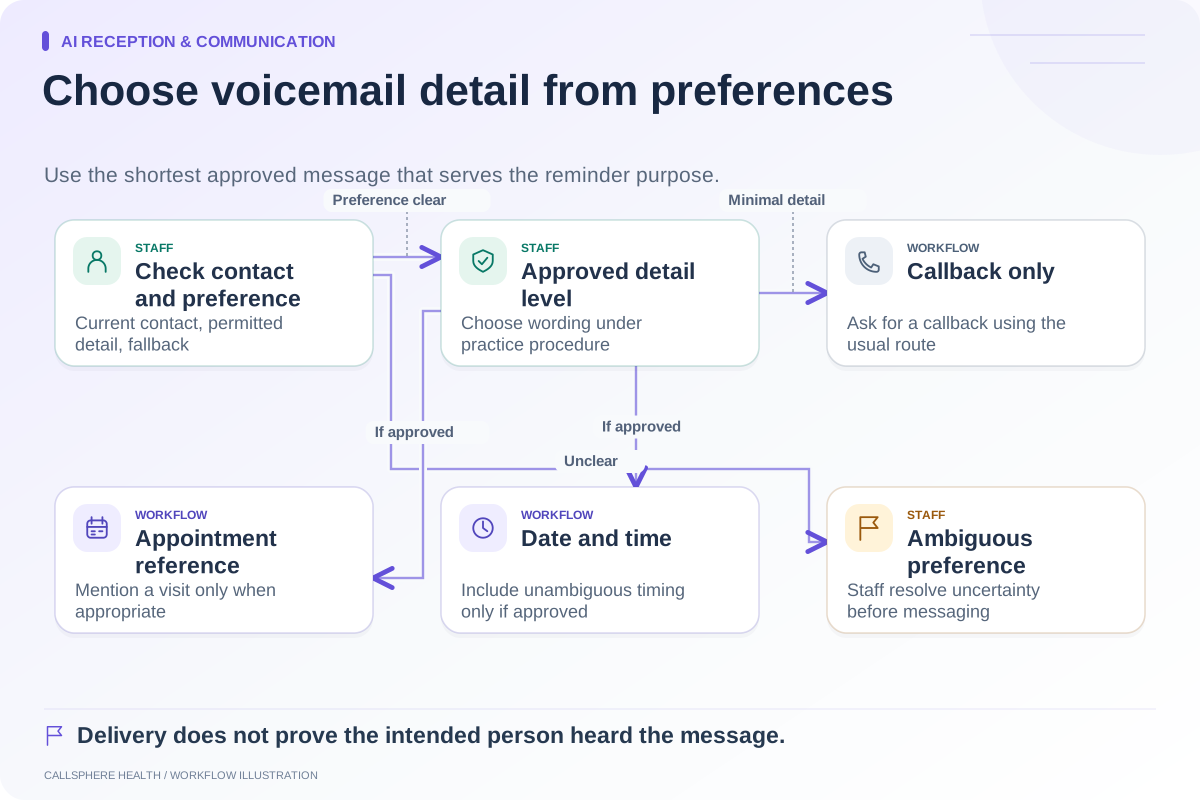
The most defensible thing a therapy practice can do is stop improvising and standardize. A content-neutral callback message needs only three elements: your first name (or a neutral practice name the client already knows), a callback number, and a request to call back. Nothing else.
A safe template sounds like this: "Hi, this is a message for [client first name]. This is Sam returning your call. Please call me back at 555-0148. Thanks." Notice what is absent. No "therapist." No "counseling office." No "about your appointment on Thursday." No "regarding your treatment." The message accomplishes its entire purpose, prompting a callback, while disclosing essentially nothing to anyone who is not the intended recipient.
If you must confirm an appointment by voicemail, and the patient has agreed to voicemail confirmations, keep it to date and time with zero clinical context: "This is Sam confirming your appointment on Thursday at 4. If you need to change it, call 555-0148." That is the ceiling, not the floor, and you only reach for it when the client has opted in.
Three operational rules make this hold up:
- Capture the preference at intake. Ask every new client, in writing, how they want to be contacted and whether voicemail is acceptable. Document it. This both satisfies 164.522 and gives you a clear record if a question ever arises.
- Default to the narrowest message when in doubt. If you are unsure whether the number is a shared line, treat it as one.
- Never let a rushed clinician be the compliance control. The moment "what do I say" is a judgment call made forty times a week between sessions, an eventual slip is a matter of statistics, not character.
That last point is where most solo practices are quietly exposed. You are the front desk. You are also the clinician, the biller, and the scheduler. The safeguard cannot depend on you remembering the rule at 4:52 on a Friday.
Where AI Messaging Enforces the Rule Every Single Time
This is exactly the kind of repetitive, high-stakes, easy-to-fumble task that belongs in a system rather than in a tired human's head. An AI front desk that handles callbacks and reminders can be configured to leave one fixed, minimum-necessary voicemail, the same way, on every attempt, with no clinical content and no improvisation. It does not get rushed. It does not decide, mid-message, to be helpful by mentioning the reason for the visit.
Concretely, HIPAA compliant phone answering small practice automation changes the voicemail problem in a few ways. The outbound message is a locked, content-neutral script you approve once. The system checks the client's stored communication preference before it dials, so a "no voicemail, text only" restriction is honored automatically rather than depending on memory. When a client has opted into secure messaging, it can send a secure text link instead of speaking anything aloud, moving the actual detail behind authentication where a car speaker cannot broadcast it. And every message left is logged with a timestamp, which is the kind of documentation that turns a "did you say too much" question into a two-minute lookup.
For a behavioral-health caller, the AI can also route sensitively: capture that someone called, confirm a callback path, and hand a live-risk situation to you directly, all without narrating any of it into an unsecured mailbox. You can see how the messaging and reminder capabilities fit together on the /features page, and because this replaces the informal "I'll just call them back myself" workflow rather than adding staff, the /pricing works out to a fraction of what even a part-time receptionist trained on HIPAA would cost.
The point is not that software is more careful than you are. It is that a fixed script executed identically ten thousand times is a control, and a busy clinician deciding fresh each time is not.
Building a Defensible Record, Not Just a Careful Habit
Compliance is partly about doing the right thing and partly about being able to show that you did. If a client ever complains that a voicemail outed them to a family member, the question OCR or your own risk review will ask is: what was your process, and did you follow it? "I try to be careful" is not a process. "We use a fixed minimum-necessary script, we record each client's voicemail preference at intake, we honor confidential-communication requests, and we log every message left" is.
Put the four pieces in place and you have both the habit and the record: a written, content-neutral callback script; a documented per-client communication preference; an accommodation path for restricted-communication requests under 164.522; and a message log. Whether you enforce those with sticky notes and willpower or with a system that does it automatically, the standard is the same. The difference is how often the standard actually gets met on a Friday afternoon when you are nine minutes behind.
So, can a therapy practice leave PHI in a voicemail? You can leave a message, but you should leave almost no PHI at all: a name, a number, and a request to call back. Everything past that is a disclosure you probably do not need to make, and in behavioral health, the disclosure you did not need to make is the one that ends up in a complaint. Decide the script once, when you are calm, and then make sure it is the script that runs every time, especially when you are not.