Every group therapy practice has a claim like this buried in its aging report. A new client called, the front desk confirmed the insurance was "active," the therapist ran eight weekly sessions of 90837, and then the whole batch bounced: the plan was a Medicaid managed-care product that authorized six visits up front, the practice delivered fourteen, and the eight over the cap are simply unbillable. No appeal recovers them. The coverage was real. The authorization was not. And the two got quietly folded into a single green checkmark on the scheduling screen.
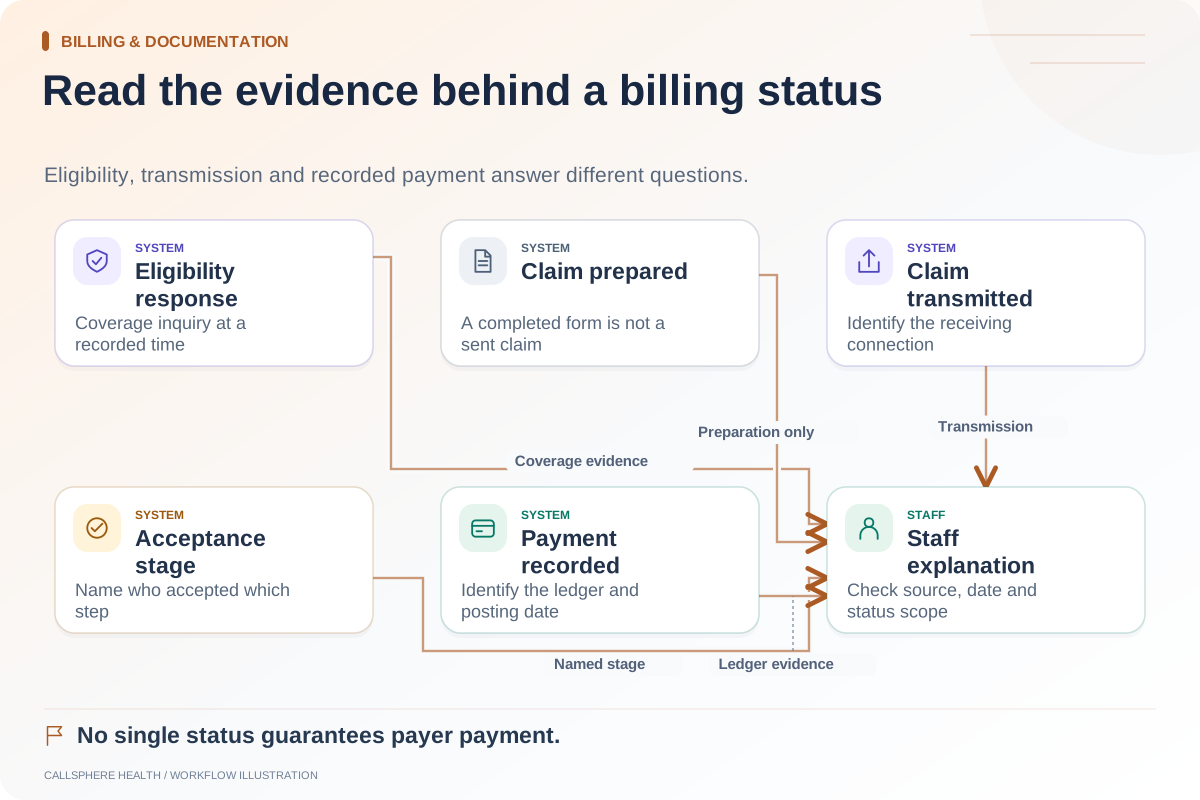
That collapse is the core problem in behavioral health billing. Eligibility and prior authorization are different questions with different answers, and a patient eligibility and benefits verification service exists precisely because reading the full benefit picture, per payer and per plan, is slower and more error-prone than any busy front desk can sustain by hand. This piece pulls the two apart, shows where behavioral-health payers hide the traps, and puts a dollar figure on the sessions you are writing off when the check gets skipped.
Two checks that get collapsed into one
Start with clean definitions, because the confusion is not academic. It costs sessions.
Eligibility verification answers: is this policy in force on the date of service, and what does it pay? A complete answer includes the outpatient mental-health copay or coinsurance, the individual and family deductible and how much remains, any annual or per-benefit visit limit, telehealth coverage for your place-of-service and modifier, and whether the plan is in or out of network with you. It is a snapshot of the benefit.
Prior authorization answers a different question: has the payer pre-approved this specific service for this specific client, and what is the authorization number? Auth is permission to render. It is issued in advance, tied to a service and a unit count, and it expires. A payer will happily confirm a patient is eligible and then deny the claim because you never obtained the auth their plan required for that service.
Here is the trap in one line: eligibility tells you the plan will pay for covered, authorized services; it does not tell you the service is authorized. The front desk that treats an active response as a green light to schedule twenty sessions is answering the wrong question. Active coverage unlocks the door. Authorization is whether you were allowed into the room.
Where behavioral-health payers hide the session limits
Behavioral health is uniquely exposed to this because the benefit structure carries limits and carve-outs that medical benefits usually do not.
The first is the carve-out. A patient hands you a card that says Aetna or Cigna, but the mental-health benefit is administered by a separate managed behavioral vendor: Optum/United Behavioral Health, Carelon (formerly Beacon), or Magellan. Your network status, your fee schedule, and any authorization requirement all live with that vendor, not the medical plan printed on the card. Verify eligibility against the medical payer alone and you have verified the wrong entity entirely.
The second is the annual visit cap. Some plans, and a large share of Medicaid managed-care products, cover a fixed number of outpatient behavioral visits per year, or a fixed number before continued-care authorization is required. That number sits in a limitation accumulator in the benefits response, and it moves: if the client saw another therapist earlier in the plan year, the visits you think you have may already be spent.
The third is EAP. Employee assistance program sessions are a common front door into a therapy practice, and they are almost always authorized as a discrete block, often three to eight sessions, under a specific EAP authorization number that is not the same as the client's regular medical insurance. Bill EAP sessions to the medical plan, or run past the authorized count, and the sessions are unbillable to either.
The fourth is the telehealth detail: whether the plan covers behavioral telehealth for your place-of-service code and required modifier, and whether that coverage is permanent or riding a temporary policy that can lapse. A bare active check confirms none of these four. The information exists in the full benefits response, in the mental-health service-type segments; the problem is that reading it for every client, across payers that each format the answer differently, is exactly the tedious work a slammed front desk skips under pressure.
Which therapy services actually require prior authorization
The rule that trips up new billers is that authorization requirements track the payer and the level of care, not a tidy list of CPT codes you can memorize once.
Routine outpatient psychotherapy is the forgiving case. On most commercial PPO plans, 90832, 90834, and 90837 do not require prior authorization, and you can schedule a standing weekly slot without a number in hand. But the exceptions are frequent enough to be dangerous. Many Medicaid managed-care plans authorize outpatient therapy in blocks and require a continued-stay review to extend. Some HMO products require a referral or an initial auth. EAP always runs on its own authorized count.
The higher-acuity services are where auth is the norm, not the exception:
- Psychological and neuropsychological testing (96130 through 96139) routinely needs prior authorization, sometimes with the specific hour count pre-approved, and a repeat battery within a payer's lookback window is a reliable denial without one.
- Intensive outpatient (IOP) and partial hospitalization (PHP) almost always require authorization and periodic concurrent review to continue.
- Transcranial magnetic stimulation (TMS) is a prior-auth-heavy service with medical-necessity documentation requirements attached.
- Extended or crisis session codes and certain add-ons can trigger review on plans that flag them for utilization management.
The operational takeaway is not "memorize which codes need auth." It is that you cannot know from the code alone. The same 90837 that is auth-free on one client's PPO needs a continued-care authorization on the next client's Medicaid plan. That is why the verification step has to resolve both questions, eligibility and authorization requirement, for each client before the first session, and why doing it reliably by hand across a full schedule is the thing that quietly falls apart.
The unbillable-session math a missed step creates
Put numbers on it, because the loss is invisible until you total it.
Take a group practice with eight therapists, each seeing about 25 clients a week: roughly 200 sessions weekly, or about 10,000 a year. At an average reimbursement near $130 for a 90837, that book is worth around $1.3 million a year in session revenue. Now assume the practice runs past caps, misses EAP counts, and skips auth on testing at a modest rate of just 2 percent of sessions. That is 200 unbillable sessions a year, roughly $27,000 written off to a step that was skipped, not to care that was denied for cause. Push the miss rate to 4 percent, which is entirely realistic for a practice leaning on active-only checks, and you are past $50,000.
The write-off understates the damage, too. An unbillable session is not a wash; you paid the therapist's hour, you occupied the room or the telehealth slot, and you generated a patient balance you now have to either chase or absorb. Chasing a client for a session you failed to authorize is a bad conversation and a worse retention risk in behavioral health, where the therapeutic relationship is the product. And denials for no-authorization and exceeded-limits do not just cost the session; they inflate your days in AR, consume biller time on appeals that mostly fail, and mask the practices that are actually recoverable.
flowchart TD
A[New client books] --> B{Coverage active}
B -- No --> C[Self pay or reschedule]
B -- Yes --> D[Pull full benefits]
D --> E{Behavioral carve out}
E -- Yes --> F[Verify with carve out vendor]
E -- No --> G[Read visit cap and telehealth]
F --> G
G --> H{Service needs prior auth}
H -- Yes --> I[Obtain auth before session]
H -- No --> J[Confirm remaining visits]
I --> K[First session is billable]
J --> KThe diagram is the whole point of the two-step model: the "coverage active" branch is only the first gate. Every box below it is a question active status never answers, and every unanswered box is a place a session goes unbillable.
How front-loaded verification closes the gap
This is the work a patient eligibility and benefits verification service is built to carry, and it is where CallSphere's automation replaces the manual grind rather than a hire you cannot justify.
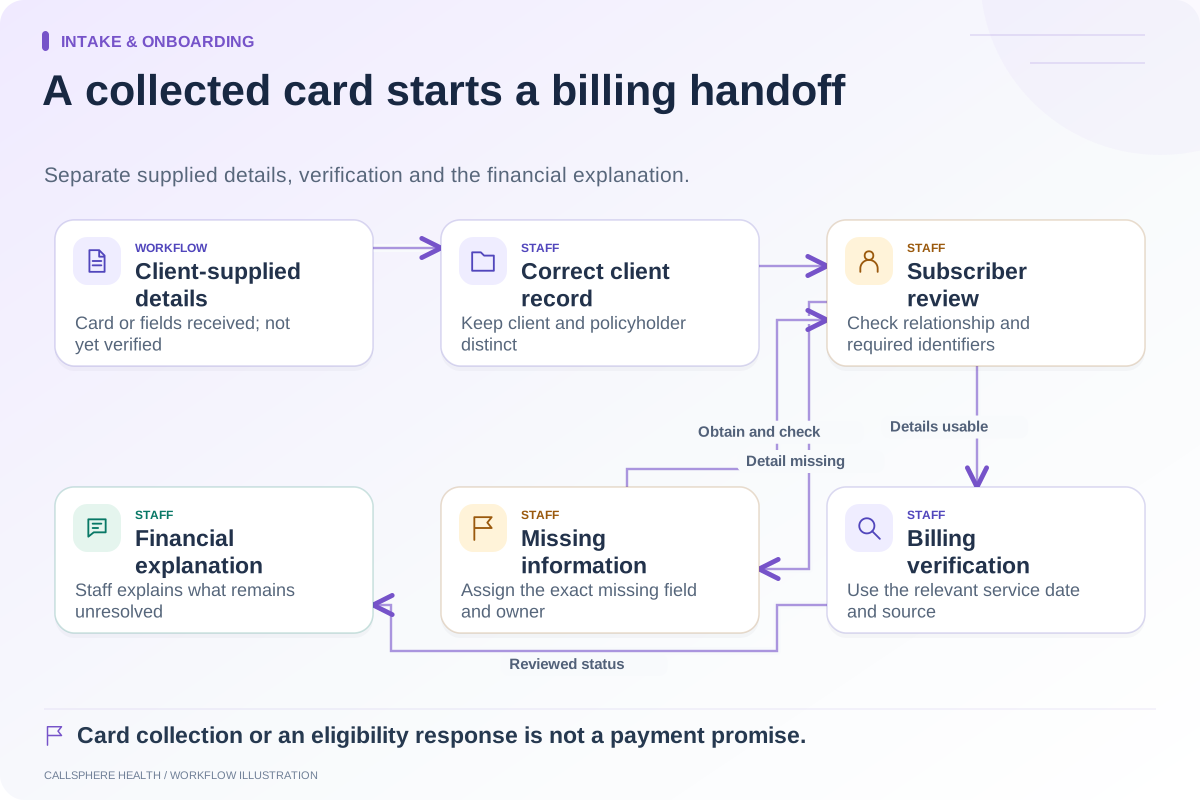
When a client books, CallSphere's AI front desk captures the insurance details during the same call it uses to schedule, in English or Spanish, without a staffer keying data between rings. It runs the eligibility transaction and reads the full benefits response, not a bare active flag: the outpatient copay or coinsurance, the remaining deductible, the visit-limit accumulator, telehealth coverage for your place-of-service, and the network status. It surfaces the behavioral-health carve-out so your team verifies against Optum, Carelon, or Magellan when that is where the benefit lives, instead of confirming the wrong payer. And it flags the services on your schedule that typically need prior authorization, so testing, IOP, and TMS never reach the therapist's calendar without someone assigned to secure the number first.
The output your biller sees is an exception list, not a stack of raw payer screens: this client has four visits left before continued-care review, this EAP authorization covers six sessions, this testing appointment has no auth on file. Front-office staff review verified snapshots in seconds and spend their attention on the handful of accounts that actually need a human, which is the same shift that pulls call volume and repetitive intake off an overloaded desk. You can see how the front desk, scheduling, and verification pieces fit together on the /features page, and the /pricing page lays out the flat monthly cost against the fully loaded price of a dedicated verification hire.
Automation does not remove clinical judgment or the payer's decision. It removes the reason the step gets skipped: the tedium of reading a dozen benefit formats for every client on a full schedule, which is exactly what a stretched front desk stops doing the moment the phones get busy.
A front-desk sequence that stops writing off sessions
If you change one workflow this quarter, make it the order of operations before a new client's first visit. Confirm the plan is active. Pull full benefits and read the mental-health segments, not just the status line. Resolve the carve-out and verify with the vendor that actually holds your contract. Check the visit cap and how many sessions are already spent this plan year. Confirm telehealth coverage for how you actually deliver care. Then, and only then, determine whether the service you are about to render needs prior authorization, and secure the number before the session, not after the denial.
That sequence is the difference between a benefit you verified and a benefit you assumed. Active coverage was never the finish line; it was the first of six questions, and in behavioral health the other five are where the money is. Whether a service you cover on your schedule this week is billable comes down to whether someone answered all six before the client sat down, which is precisely the check that a verification service runs the same way every time, and a busy front desk runs only until the next call comes in.